Saturday, May 16, 2026

Kenrex - A True Crime Story Explodes in the Telling

Reviewed by Judd Hollander - 

Jack Holden is magnificent as he takes on the roles of over 30 characters in the one-man show Kenrex at the Lucelle Lortel Theatre. Written by Holden and Ed Stambolluian, this transfer from London where it was nominated for multiple Olivier Awards, examines an actual incident and its lingering aftermath.

Skidmore, Missouri is a place located in the middle of nowhere on your way to anywhere else. It consists mainly consists of farms, one general store, one bar and one bank. A tight knit community of about 400 people where everybody knows everybody else’s business. The year is 1981 though the story begins somewhat earlier. 

                                    Jack Holden in KENREX. Pamela Raith Photography

Ken Rex McElroy, known to all as “Ken Rex,” is the longtime town bully and someone you do not want to cross. The 15th of 16 children in a migrant family, he gets by doing odd jobs, the last of which has left him in chronic pain due to an accident. He also has a deep hatred for those, such as farmers, who have inherited generational wealth or property. Over the years Ken has had numerous run-ins with the law and been accused of such crimes as property damage, assault, breaking and entering, burglary and arson. Yet each time he’s brought to court, his lawyer Richard McFadin is able to get the charges dismissed by deliberately twisting the facts. There’s also the issue of numerous, albeit unproven instances of witness intimidation. Ken at one point proclaiming he’s never spent a single night in jail.

                                   Jack Holden in KENREX. Photo by Manuel Harlan

Ken’s undoing begins shortly after a recent acquittal when, at a town festival, he encounters 14-year-old Trena McCloud, who quickly becomes enamored with him and soon after is pregnant. The two quickly marrying as a wife in Missouri can’t be forced to testify against her husband. When the lovestruck teenager is approached at the general store by someone who only wants to make sure she’s okay, the upset Trena reports the encounter to Ken, who returns with a shotgun. Despite attempts to defuse the situation, shots are fired and one person is left critically wounded.

Thrown into the aftermath of all this is David Baird, the new prosecutor for the county and who, as the show begins, is making a statement to an unseen federal agent. It seems Ken was heading to jail for his role in the shooting until Baird makes an unexpected move which puts Ken back on the streets. Yet even as Baird believes his actions will finally stop Ken once and for all, that day of reckoning gets pushed back due to McFadin’s delaying tactics and leaves Ken free to roam and threaten. Until some residents decide to take matters into their own hands.

Playing like a true-crime docudrama or a “Law and Order” episode, one is quicky drawn into this gripping story, where the fear, anger and helplessness of the townspeople become quite palpable as they see Ken time and again the use legal system to his advantage. In the end, the question becomes one of control and what someone will do to retrain that control or conversely, take it away from another.

                                     Jack Holden in KENREX. Photo by Manuel Harlan

There are several musical interludes presented, with composer John Patrick Elliott providing quite effective onstage accompaniment, if a bit too loud at times. A particular highlight is an extended sequence that introduces the McFadin character and which feels very much like a spoof of low budget local advertisements seen on late night television. 

Though much of the first act is basically a set up for what is to follow, there are more than enough twists and turns to keep the audience on the edge of their seats, even if one is already familiar with the outcome. Key to this is Holden’s excellent performance as he literally transforms himself with the physical characteristics and attitudes of one character to another from one moment to the next. Just as critical is Stambollouian’s exemplary directorial work which keeps the pacing of the story continually taut and leaving one feeling that something unexpected might happen at any moment. Lighting by Joshua Pharo and sound by Giles Thomas are also important elements in presenting the proper ominous atmosphere for the work.

                                       Jack Holden in 'KENREX. Photo by Matthew Murphy

The show also depicts a shifting attitude when it comes to morality, with no person able to claim that high ground for long. Ultimately, the play asks how far someone will go to protect themselves and their loved ones when all legal avenues that exist prove to be of no help. In Kenrex there are no winners, only those who must live with never knowing the full story of what happened, and those who know exactly that, but who will never be able to speak of it. Though if underlying story was truly fiction, there’s just enough of a loose end to lay the groundwork for a possible continuation of what we have seen unfold on stage.

Less a question of right and wrong than one of what choice did they have, Kenrex will keep you glued to your seat from beginning to end.

Featuring: Jack Holden
Voices: Kelly Burke (Voice of Annette Parker), James Sobel Kelly (Voice of David Baird)

Kenrex: A True Crime Thriller

Written by Jack Holdern & Ed Stambollouian

Composed by John Patrick Elloitt

Scenic & Costume Designer: Anisha Fields

Lighting & Video Designer: Joshua Pharo

Sound Designer: Giles Thomas

Casting Director: Taylor Williams, CSA

Associate Director: Rox Golden

Music Supervision: John Patrick Elliott

Company Manager: Susan Keappock

Production Manager: Sophie Larin/LJPM

Production Stage Manager: Amber Johnson

Stage Manager: Sydney Scheer

Movement Director: Sarah Golding

Directed by Ed Stambollouian


Lucille Lortel Theatre
121 Christopher Street, New York City
Tickets: https://Kenrextheplay.com
Running time: 2 hours, 15 minutes, one intermission
Closes: June 27, 2026


Friday, May 15, 2026

The Balusters - Where good intentions and hypocrisy go hand in hand

Reviewed by Judd Hollander

Looking for that extra advantage to protect ones’ interests is at the heart of David Lindsay-Adaire’s new Broadway comedy The Balusters.

The East Coast community of Vernon Point consists of a historical district with Victorian homes on treelined streets, with stores, apartment buildings and other structures nearby. It’s close to the city but isolated enough to feel removed from it. Helping to maintain this feeling is the local Neighborhood Association, whose membership consists of a cross-section of races, genders, ages, and opinions. The organization’s long-time president is Elliot (Richard Thomas), a real estate broker and seemingly affable sort.

Hosting the latest monthly meeting is Kyra (Anika Noni Rose) an African American and newest member of the Association. Kyra, her husband and young children have recently arrived from Baltimore to start fresh, as it were. Having had a volatile experience as a Board member of the coop where she once lived, Kyra is mostly concerned with being able to fit into her new surroundings without causing any controversy.

(L-R) Kayli Carter, Carl Clemons-Hopkins, Anika Noni Rose and Jeena Yi in MTC's The Balusters. 
                                                        Photograph: Jeremy Daniel
In between discussions of disappearing packages, dog poop and the proper type of balusters (spindles) used in construction of stairs and railings, Kyra does suggest the installation of a traffic light for the crosswalk outside her home. After the formation of a committee to study the matter, learning the official difference between a speed bump and speed hump, and feeling the facts are on her side, Kyra begins to reach out online to the different residents in the community for their input, without first informing Elliot, who feels that such an inclusion will disturb the historical aesthetics of the neighborhood.

During subsequent meetings, as Eliott and Kyra warily circle one another, we begin to learn about what makes the rest of the Association members tick. At least one of whom owes their position to a sort of nepotism. In between casual conversations, caustic remarks, and politically incorrect comments – including a discussion of the terms “Latino,” “Latinx” and “Hispanic” – and the continual sharing of neighborhood gossip, it becomes apparent none of them is as fully transparent as they appear. Each supposedly trying to do the right thing for the community, but all take their own personal situations into account when making decisions. Be it the location of a traffic light, hiring people to work for them at less-than-optimal conditions, or not obeying certain rules – such as disposal of a certain type of refuse. Matters eventually culminate in an emotional showdown where everyone must choose a side while also being called to account for their actions.

Clockwise from Left: Ricardo Chavira, Carl Clemons-Hopkins, Richard Thomas, Anika Noni Rose, Jeena Yi, Marylouise Burke and Kayli Carter in MTC's The Balusters. Photograph: Jeremy Daniel

In addition to the play’s overall irony and one-liners that go off like firecrackers, Lindsay-Adaire also focuses on generational change. As when Elliot shows Kyra old photographs of the neighborhood, only for her to point out how all the people pictured are white. Elliot also undercuts Kyra’s traffic proposal by knocking on doors and talking directly to elderly homeowners who don’t use social media. Something Kyra apparently never considered when using Facebook.

Smartly directed by Kenny Leon, the entire cast plays off each other very well. Thomas works perfectly as a man who passionately believes he is doing the right thing in trying to keep the community together and that change need to be incremental and carefully thought out. However, his possessiveness has caused him to treat the neighborhood as his own personal fiefdom where his prejudices, particularly those concerning class distinction, eventually come to the fore.

     Richard Thomas, Anika Noni Rose in MTC's The Balusters. Photograph: Jeremy Daniel

Noni Rose’s character is a perfect match for Elliot, a fresh face in the Association who starts out wanting no trouble with anyone, but who won’t will let herself be pushed around. Determined to pass her own agenda, even if that entails using insider information to do so, she ends up being perhaps the biggest hypocrite of all.

Also key to the story is Margaret Colin as Ruth, an ally of Elliot who initially seems just a bit too sure of herself when making comments others wouldn’t dare voice aloud. She also turns quite serious when delivering a heartfelt speech about how, when judging someone, it’s important to look at what they’ve done in their entirety, rather than a single incident.

                              Margaret Colin in MTC's The Balusters. Photograph: Jeremy Daniel

Another standout is Marylouise Burke as an elderly member of the Association who may initially seem slow on the uptake, but is sharper than she lets on. She also figures in a conversation concerning who is more at fault when it comes to wrong assumptions, the person who made the error or one who knows the truth but doesn’t correct it.

The only part of the play which doesn’t ring true, other than it feeling like a sitcom at times, is a climatic physical altercation that comes off as quite unnecessary and rather jarring. It’s also not in keeping with the character in question as we have come to know them.

Serving morality mixed with laughter, The Balusters looks at imperfect people trying to make decisions for the many while not always believing the rules apply to everyone. 

(L-R) Jeena Yi, Marylouise Burke, Michael Esper and Richard Thomas in MTC’s The Balusters. Photograph: Jeremy Daniel

Featuring: Marylouise Burke (Penny Buell), Kayli Carter (Willow Gibbons), Ricardo Chavira (Isaac Rosario), Carl Clemons-Hopkins (Brooks Duncan), Margaret Colin (Ruth Ackerman), Michael Esper (Alan Kirby), Maria-Christina Oliveras (Luz Baccay), Anika Noni Rose (Krya Marshall), Richard Thomas (Eliott Emerson), Jeena Yi (Melissa Han)

The Balusters

Scenic Design: Derek McLane

Costume Design: Emilio Sosa

Lighting Design: Allen Lee Hughes

Original Music & Sound Design: Dan Moses Schreier

Hair, Wig & Make-up Design: J. Jared Janas

Fight Direction: Thomas Schall

Vocal Coach: Deborah Hecht

Movement & Associate Director: Ioana Alfonso

Casting: Caparelliotis Casting/Kelly Gillespie

Production Stage Manager: Tripp Phillps

Stage Manager: Janette Braggs

Directed by Kenny Leon


Presented by The Manhattan Theatre Club at the Samuel J. Friedman Theatre

261 West 47th Street, New York City

Tickets: www.manhattantheatreclub.com

Running time: 1 hour 55 minutes, no intermission

Closes: June 21, 2026


Thursday, April 16, 2026

Titus Andronicus – Not for the Squeamish

Reviewed by Judd Hollander

One of the bloodiest works in the Shakespeare canon, Titus Andronicus offers a stark judgment about what happens when one follows custom too closely and where, but for a little mercy, things might have turned out quite differently.

For the past ten years, the Roman Empire has been locked in a war with the Goths. Rome finally emerging victorious thanks in no small part to the battlefield efforts of General Titus Andronicus (Patrick Page). Titus helped bring an end to the war with the capture of Tamora (Francesca Faridany), the Goth Queen, along with her family and her Moor lover, Aaron (McKinley Belcher IIII). Despite his great success, the war has cost Titus dearly. Three of his six sons perished in battle, while some of those who survived are left with physical scars they will carry the rest of their days.

                  (L-R) Anthony Michael Lopez, Anthony Michael Martinez, Patrick Page, Zack Lopez Roa.
                                                            (Photo: Carol Rosegg)

Returning home in triumph with his prisoners in tow, Titus faces a new challenge. The Emperor of Rome has died and his sons Saturnus (Matthew Amendt) and Bassianus (Howard W. Overshown) each seek the crown. Because of the respect he commands, Titus agrees to decide who should be Rome’s new ruler, a role he himself turned down, citing his advanced years. Titus selects Saturnus, a choice based not so much on ability, but on custom - Saturnus being the eldest son. Saturnus also has designs on Titus’ daughter Lavinia (Oliva Reis), who rebuffs his advantages, as she and Bassianus are deeply in love and have announced their own plans to marry. In response, Saturnus decides to take the captive Tamora as his queen. Tamora quickly accepts, not only because doing so would mean freedom for herself and her family, but also so she can revenge herself against Titus who, in keeping with a standard practice, killed one of her sons before her eyes, despite her pleas to spare his life.

Tamora quickly sets her plan in motion, crafting a scenario where her sons Demetrius (Adam Langdon) and Chiron (Jesse Aaronson) murder Bassianus and then rape and mutilate Lavinia. They also conspire to frame two of Titus’ sons for these crimes, who are quickly sentenced to death despite Titus’ pleas, and a very personal sacrifice in an effort to save their lives. Stunned by his sudden reversal of fortune and emotionally battered by tragedy, Titus seems to descend into madness as Tamora and her family prepare to deliver the final killing blows against him. However, Titus’ manner may be in fact somewhat exaggerated as he hatches his own scheme of grisly vengeance, no matter how terrible the price he may be forced to pay in the end.

As Shakespeare quite graphically points out, the idea of revenge, even if it is under the auspicious of moral justice, can often end in disaster. Titus in particular becomes so set in his course any personal misgivings he might have to the contrary won’t allow him to deviate from his mission. Filled with numerous scenes that are quite painful to watch, especially what happens to Lydia, perhaps the only true innocent in the story, the play sends a clear message when it comes to the ultimate price of such actions. No matter how in some cases the audience may actually cheer when some of those involved receive their just deserts – in at least one case, quite literally.

(L-R) Patrick Page, Zack Lopez Roa, Anthony Michael Martinez, Howard W. Overshown, Enid Graham. (Photo: Carol Rosegg)

Page is positively brilliant in the title role, commanding the stage and holding the audience’s attention whenever he appears. Be he undertaking a plan of revenge, pleading helplessly for the lives of those he loves or crying out in anguish in moments of literal pain. He also perfectly embodies the air of a war-weary soldier feeing the weight of years pressing down on him. 

The rest of the cast acquit themselves admirably, though many of their roles do not come off as fully formed as Titus. Faridany works well as the scheming and vengeance seeking Tamora, who will use anyone, including members of her own family to achieve her ends. Amendt is fine the foppish Saturninus a man who, for all his outward bravado, is more than content to let his new queen make all the decisions. Aaronson and Langdon are effective as the somewhat smarmy Chiron and Demetrius. Belcher is good as the always-seeing and observing Aaron, though the character often seems to exist mainly for the purpose of giving expository speeches and showing how even the basest among us is not above pleading for mercy when it involves someone he cares about. Reis strikes a poignant note as the tragic Lavinia, who is determined that the truth of what happened to her finally be known. Enid Graham is quietly effective Marcia, the Tribune of the Roman people, who is also Titus’ sister.

Jesse Bernger’s direction is good keeping the action moving as the play moves from one blood-soaked scheme to another. A particularly nice touch was to have Aaronson and Langdon play their roles in such a deliberately annoying way that no one has any sympathy for them when they finally meet their own ends. Also nicely striking a macabre note is costume designer Emily Rebholz, who provides a particularly fitting outfit for Titus as he holds court in a final confrontation.

(L-R) Anthony Michael Martinez, Zack Lopez, Howard W. Overshown, Blair Baker, Enid Graham, Anthony Michael Lopez, Matthew Amendt, Patrick Page, Francesca Faridany. (Photo: Carol Rosegg)

Not for the faint of heart and certainly not the play to introduce anyone to the world of Shakespeare, Titus Andronicus offers a powerful warning about what happens when one too closely adheres to tradition and who then must ultimately reap everything they have sewn. 

Starring Patrick Page (Titus Andronicus).

With Jesse Aaronson (Chiron), Matthew Amendt (Saturninus), Blair Baker (Alarbus), McKinley Belcher III (Aaron), Francesca Faridany (Tamora), Enid Graham (Marcia Andronicus), Amy Jo Jackson (Nurse), Adam Langdon (Demetrius), Anthony Michael Lopez (Lucius), Anthony Michael Martinez (Valentine), Howard W. Overshown (Bassianus), Olivia Reis (Lavinia), Zack Lopez Roa (Caius)

Scenic Design: Beowulf Boritt

Costume Design: Emily Rebholz

Lighting Design: Jiyoun Chang

Composer & Sound Design: Adam Wernick

Sound Design: Shannon Slaton

Prop Supervisor: Anya Kutner

Wig & Makeup Design: Tommy Kurzman

Fight Director & Intimacy Coordinator: Rick Sordelet

Voice & Speech Coach: Dawn-Elin Fraser

Dramaturg: Ayanna Thompson

Production Stage Manager: Jenn McNeil

Production Manager: Gary Levinson

General Manager: Leah Michalos

Casting Director: Alexandre Bleau

Directed by Jess Berger


Titus Andronicus

Presented by Red Bull Theater

Pershing Square Signature Center

Alice Griffin Jewel Box Theatre

480 West 42nd Street, New York City

Tickets: www.redbulltheater.com

Running time: 2 hours, 15 minutes, one intermission 

Closes: May 3, 2026


Monday, February 16, 2026

High Spirits – Jolly Good Fun

Reviewed by Judd Hollander

In Stockbridge, Massachusetts during the summer of 1984 I had my first and until now, only encounter with a production of the 1964 Broadway musical “High Spirits.” After seeing the show, with book, music and lyrics by Hugh Martin and Timothy Gray, and based on Noel Coward’s 1941 comedy “Blithe Spirit,” I remember thinking how much I enjoyed it overall, but that the book was somewhat uneven.

Having the opportunity to see the recent Encores! production of “High Spirits,” I realized many of my impressions from back then still hold true. That’s not to say this show isn’t worth seeing, as there is certainly quite a lot of enjoyment to be had. Thanks to a superlative cast, a sparkling score, some delightful production numbers and the fantastic work of the Encores! orchestra.

In Hampstead, England, mystery novelist Charles Condomine (Steven Pasquale) and his wife Ruth (Phillipa Soo) are preparing to take part in a séance so Charles can gain some background information for his latest literary effort. Joining them are their friends Dr. Bradman (Campbell Scott), his wife Violet (Jennifer Sánchez) and the medium Madame Arcati (Andrea Martin). However, what is originally envisioned becomes something else entirely when, while trying to contact someone on the other side, Charles’ first wife Elvira (Katrina Lenk), who died seven years earlier, suddenly appears.

Phillipa Soo and Steven Pasquale in "High Spirits." Photo Credit: Joan Marcus

Charles’ astonishment quickly turns into somewhat of a predicament when it becomes obvious that only he can see or hear Elvira, who is upset to find Charles remarried to someone she finds completely unsuitable. It’s not long before the comments between Charles and Elvira grow ever more pointed, with Ruth becoming angrier by the moment as she believes Charles’ remarks are directed at her.

Charles soon realizes Elvira wants him to join her on her side of the veil and is doing her best to make that happen. In a fit of desperation, Charles arranges for Madame Arcadi hold another séance in order to send Elvira away. When her efforts to do so only make things worse, it sets in motion a culmination of events that no one, living or dead, fully sees coming.

Katrina Link and the company of "High Spirits." Photo Credit: Joan Marcus

At its core “High Spirits” offers a gentle lesson about the realities of change and how the past can be viewed quite differently by different people. Despite the intense passion Elvira and Charles shared during their marriage, she apparently cheated on him multiple times. At the same time, while Charles and the more sedate Ruth live quiet contented lives, the thought of his reclaiming what he once hand with Elvira proves to be an almost irresistible temptation.

The dialogue is excellent, the air literally thick with crackling retorts and witticisms which feel perfectly at home in an English drawing room comedy. The problem is that the music and conversations don’t always blend well together. The different numbers, especially when they come after long stretches of speech, often feel jarring and unnecessary as they struggle to mix with the verbal rhythms that have come before.

The irony is that the songs are all quite excellent, many of them getting their message across wonderfully. Among the highlights is “The Bicycle Song,” which gleefully introduces the alternatively mysterious and whimsical Madame Arcati; the robust “Where is The Man I Married?,” where Charles and Ruth wonder what became of the person they once knew - and which would be perfectly at home in the musical “Kiss Me, Kate.” The latter song also hearkens back to the idea of how people change over the years. Two other numbers hitting home are “What In The World Did You Want?” as Charles, Elvira and Ruth take turns lambasting one another as each tries to claim the moral high ground; and the jazz-infused “Faster Than Sound” where Elvira recounts what it’s like to be a ghost and the advantages that come with it.

Steven Pasquale and Katrina Link in "High Spirits." Photo Credit: Joan Marcus

With “High Spirits” Encores! is firmly in its element, that of exploring old musicals which may never be revived except in situations like this. The actors may read from scripts and carry them about, but are totally in character throughout the show, except when someone misses a line or two.

Pasquale is wonderful as Charles, a man who at the outset seems quite happy with his life, but who soon finds himself pinning for the “good old days” before realizing that maybe they weren’t always that good. Something quite apparent at the end of the show when he tries to finally get in the last word. 

Soo is delightful as Elvira, a woman suddenly returned to her former existence and not at all happy about what she finds there. Her devil-may-care attitude hiding a more spoiled and calculating air where her own goals and pleasures are most important of all. As she makes clear with the jaunty “Home Sweet Heaven,” where she sings about what it’s like on the other side, name dropping everyone from Homer, Aristotle and Freud to Casinova, Lizzie Borden and Atilla.

             (L-R) Jennifer Sánchez, Campbell Scott and Rachel Dratch in "High Spirits." Photo Credit: Joan Marcus

Lenk is excellent Ruth who goes from a posed, confident woman to one hilarious meltdown after another while trying to come to terms with Elvira’s return, which has thrown her ordered world into a continual tizzy. Elvira’s reappearance also triggers Ruth’s hidden anxieties about whether Charles was truly ready to move on and be with her. These fears explored in “Was She Prettier Than I?,” one of the numbers that doesn’t quite jell with the dialogue that has come before.

Martin is absolutely perfect as the scenery chewing Madame Arcati, who never met a spirit she didn’t like. Part mysterious, part beatnik, she attacks her lines and scenes with impervious gusto. Though the character may never be in as control as she might hope, there’s never doubt that no matter the situation, she will give it all.

                       Andrea Martin and the company of "High Spirits."  Photo Credit: Joan Marcus

Rachel Dratch offers a special treat as the Condomine’s mostly silent maid, Edith. With seemingly little more to do than agree with her employers, her every appearance becomes an enjoyable comic treat, with an unexpected talent no one, least of all herself, imagines possible. She’s also excellent in “Where is The Man I Married?” where she’s run ragged as she continually tries to serve Charles and Ruth coffee according to their ever-changing instructions.

The only real casting issue is the use of Scott as both Dr. Bradman and Noel Coward. The latter basically a device to allow him to read stage directions and set each scene properly as part of Billy Rosenfield’s concert adaptation for this production. This premise works well enough initially but starts to become rather tedious as the show goes on. Especially when he is describing some of the more physical actions, which prove a distraction to what is supposedly happening on stage.

                      Andrea Martin as Madame Arcati in "High Spirits." Photo Credit: Joan Marcus

Choreography by Ellenore Scott is both tight and strong, especially in such numbers as “Where is the Man I Married?” and “Faster Than Sound.” Costumes by Jennifer Moeller come off well and the orchestral work by Harry Zimmerman, with additional orchestrations by Luther Henderson are wonderful to hear. Direction by Jessica Stone is fine, though her efforts are hamstrung at times by some of the aforementioned problems with the book.

Despite the few missteps here and there, this Encores! production of “High Spirits” made for a fun time overall and something quite delightful to behold.


Featuring: Campbell Scott (Noel Coward/Dr. Bradman), Phillipa Soo (Ruth Condomine), Rachel Dratch (Edith), Steven Pasquale (Charles Condomine), Jennifer Sánchez (Violet Bradman), Andrea Martin (Madame Arcati), Katrina Lenk (Elvira), Andrew Kober (Boy), Demarius R. Copes (Rupert), Dana Steingold (Girl).

Ensemble: Brandon Block, Delphi Borich, Marcus Byers, Jr., Demarius R. Copes, Deanna Cudjoe, Sara Jean Ford, Katie Griffith, Benjamin Howes, Caroline Kane, Andrew Kober, Ross Lekites, Devon McCleskey, Jeremiah Porter, Sean Stack, Dana Steingold, Halli Toland, Kamille Upshaw-Darrington, Kristin Yancy


"High Spirits"

Music, Lyrics and Book by Hugh Martin & Timothy Gray

Based upon "Blithe Spirit" by Noel Coward

Orchestrations: Harry Zimmerman

Additional Orchestrations: Luther Henderson

Concert Adaptation: Billy Rosenfield

Scenic Designer: David Zinn

Costume Designer: Jennifer Moeller

Lighting Designer: Bradley King

Sound Designer: Megumi Katayama

High & Wig Designer: Rob Pickens

Makeup Designer: Katie Gell

Magic & Illusions: Skylar Fox

Music Coordinator: Kimberlee Wertz

Production Stage Manager: Cynthia Cahill

Casting by The Telsey Office, Rachel Hoffman, CSA

Choreographer: Ellenore Scott

Featuring: The Encores! Orchestra

Music Director: Mary-Mitchell Campbell

Director: Jessica Stone


Presented by Encores! at New York City Center

131 West 55th Street

Running time: 2 hours 15 minutes, one intermission

Closed, February 15, 2026


Friday, March 28, 2025

The Jonathan Larson Project - Revealing A Passion That Still Burns Bright

Reviewed by Judd Hollander

Be it filled with the joy that comes with beginning a new chapter in life, political satire about truth and electability, or a somber ballad of how a musical instrument can restore one’s emotional equilibrium, every offering in the world premiere musical The Johnathan Larson Project has something deeply meaningful to say. Currently at the Orpheum Theatre in Greenwich Village, the show’s selections, some of which have never been performed publicly, help shine a light on a multi-talented artist who at age 35, left this world far too soon. 

While the show has no through storyline per se, one can quickly discern how the work is divided into specific sections. The first of which leads off with the rousing “Greene Street,” as the cast of five extolls the joys of being young and hopefully talented enough to make it in New York City. This premise of following one’s dreams continues through the next several songs as they explore the optimistic naivety youth can bring, along with the creeping realization that achieving success is not always as easy or quick as first imagined. Though there is the opportunity to unwind from such pressures via alcoholic relaxation, as shown in comedic gem “Break Out the Booze.”

(L-R) Andy Mientus, Taylor Iman Jones, Lauren Marcus, Jason Tamt in "The Jonathan Larson Project." Photo by Joan Marcus

Juxtaposed with these situations are ones that examine those who exist on the fringes of society, a place where hope has long since become a thing of the past and simply making it through the night can require the sacrifice of ones very soul. These are folks Larson himself could have seen during the years he lived in Greenwich Village.

The final third of the show assumes a more political bent, with offers that run the gamut from over-the-top satire, such as a skit focusing on the creation of the perfect candidate, to something far more grounded in reality, as when two women compare notes about what it takes to make it in a “White Male World.” Also explored is the fragility of our environment, via the almost dirge-like “Iron Mike,” about the 1989 Exxon Valdez oil spill, along with the ultimate question of who you can trust, especially when everyone seems to have their own personal version of the truth. It also helps that the show’s program contains background information on each of the numbers presented, which help to provide an extra layer of depth and understanding as to their origins.

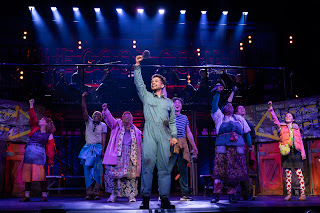
(L-R) Lauren Marcus, Andy Mientus, Jason Tam, Taylor Iman Jones, Adam Chanler-Berat in "The Jonathan Larson Project." Photo by Joan Marcus

Conceived by Jennifer Ashley Tepper, directed by John Simpkins and presented with the support of the Larson family and estate, many of the songs have an almost poetical feel to them as they pull the audience into the stories being told and the characters who inhibit them. Highlights, in addition to those already mentioned, include the ironically named “Valentine’s Day,” which shows how a desperate need for love can lead to a path from which there may be no escape.

                              Adam Chanler-Berat in "The Jonathan Larson Project." Photo by Joan Marcus

The cast is excellent, with each member of the company getting their own individual moment to shine. Also deserving of mention is the choreography by Bryon Easley, and Charlie Rosen’s work on the musical arrangements and orchestrations. 

The show also contains an overall air of poignancy as it recalls, via video clips, the circumstances surrounding Larson’s passing. He died in 1996 of an aortic dissection on the early morning of the first scheduled preview performance for the Off-Broadway run of his musical “Rent,” for which he wrote the book, music and lyrics. “Rent” would earn Larson, among other honors the Pulitzer Prize, and when the show moved to Broadway, three Tony Awards.


 (L-R) Andy Mientus, Adam Chanler-Berat, Taylor Iman Jones, Lauren Marcus, Jason Tam in "The Jonathan Larson Project." Photo by Joan Marcus

Previously staged as a concert in 2018, the show pays its subject the ultimate compliment when it notes how not a word of what Larson has written was changed for this production. 

With songs that runs a gamut of styles and emotions, The Jonathan Larson Project proves to be a wonderfully entertaining, totally infectious and extremely thought-provoking experience.


Featuring: Adam Chanler-Berat, Taylor Iman Jones, Lauren Marcus, Andy Mientus, Jason Tam

The Jonathan Larson Project

Conceived by Jennifer Ashley Tepper

Scenic Designer: Michael Schweikardot

Costume Designer: Tracy Christensen

Lighting Designers: Adam Honoré, Shannon Clarke

Video Designer: Alex Basco Koch

Sound Designer: Justin Stasiw

Wig and Hair Designer: J. Jared Janas

Music Director: Cynthia Mend

Music Supervision/Orchestration/Co-Arranger: Charle Rosen

Choreographer: Bryon Easley

Director: John Simpkins

Orpheum Theatre
126 Second Avenue
Tickets: https://thejonathanlarsonproject.com/
Running time 1 hour 35 minutes, no intermission

Closes: March 30, 2025


Wednesday, February 19, 2025

Urinetown – Still Mostly Sharp After All These Years

Reviewed by Judd Hollander

True believers, no matter where they may be on the political, social or economic spectrum, always believe they are doing the right thing. Even if there are those who refuse to see it that way, due to so-called sacrifices that must be made for the greater good. This is the message at the heart of the deliciously satiric musical, Urinetown. Created by Mark Hollmann (music and lyrics) and Greg Kotis (book and lyrics), the show’s recent run as part of the Encores! series at New York City Center marks its first major staging in the Big Apple in over two decades.

                 (L-R) Greg Hildreth as Officer Lockstock and Christopher Fitzgerald as Officer Barrel in 
             the Encores! production of Urinetown at New York City Center (photo by Joan Marcus)

For the last twenty years, the country has been plagued by drought so severe that every bit of moisture is precious. In the wake of this catastrophe, a corporation has arisen - with the tacit approval of the government - that has created a gigantic network designed to collect people’s bodily fluids to be repurposed for later use. The project supported by a tax that people must pay before they can use the Amenity Stations constructed specifically for this function. As Penelope Pennywise (Keala Settle), who runs Amenity #9, “the poorest, filthiest urinal in town,” explains more than once “It’s a Privilege to Pee.” Those who can’t afford the fee and instead use an unsanctioned area to relieve themselves are immediately rounded up by authorities and taken to Urinetown, a place whose name strikes fear in the general public and from which no one has ever returned. 

Penelope Pennywise (Keale Seattle) admonishes Old Man Strong (Kevin Cahoon) in the Encores! Production of Urinetown at New York City Center (Photo by Joan Marcus)

The imposition of the latest pee tax turns out to be the match that threatens to explode the angry powder keg the less-fortunate citizenry has become. All they need is a leader, who appears in the persona of Bobby Strong (Jordan Fisher), a young man who works for Pennywise and who recently saw his own father taken away to Urinetown. Bobby has long believed there is nothing he can do to stop the injustice he sees – where those in power get richer and those without get nothing – but his outlook changes after an encounter with the good hearted, if somewhat naive Hope Cladwell (Stephanie Styles), daughter of Cladwell B. Cladwell (Rainn Wilson), the man who created the imposing Urine Good Company and all that has since followed.

With a newly emboldened Bobby opening Amenity #9 for all to pee at no cost, and Cladwell determined to stamp out any source of rebellion before it spreads, he having no desire to return to the chaos of what came before, it is only a matter of time before these two men come into conflict, with Hope caught right in the middle.

                     Bobby Strong (Jordan Fisher) and the company of Urinetown (Photo by Joan Marcus)

Urinetown’s strength comes from its biting dialogue and absolutely brilliant score - the latter perfectly delivered by the Encores! Orchestra. Each line or lyric capable of provoking one telling realization after another, depending on how deep one cares to look beneath what is being presented on stage. These sentiments include the tenacious grasp one can have on their own personal freedom, questions of culpability, how under the right circumstances most everybody is capable of doing something they would normally consider unthinkable, the dangers of refusing to see the big picture when making a decision, and the understanding that every choice made comes with consequences.

Rainn Wilson (standing on table) as Cladwell B. Cladwell and the company of Urinetown (Photo by Joan Marcus)

For a show of this type to work, the satire it offers needs to be perfectly delivered, which sadly, is not always what happens here. The dialogue at times delivered with an extra pause, or sort of wink to the audience to allow them to be in on the joke. The different characters also need to be played with total seriousness and when they’re not, it destroys the believability of their scenes. Among those with this problem are Greg Hildreth as Officer Lockstock, a character who also serves as the show’s narrator, and whose delivery feels just off enough to made him seem part of the joke, rather than the situation he’s describing. Another person who has this issue is ensemble member John Yi. There are also moments when the show feels a bit rushed and lacking in tension, such as when Bobby and his fellow rebels are regrouping in their secret hideout after their initial clash with Cladwell.  

Wilson does a superb job as Cladwell, whose scenery-chewing rendition of “Don’t Be the Bunny” shows him to be a black-hearted realist who has no intention of relinquishing the power and control he wields. Settle does a good turn as Pennywise, a woman seemingly all business until it turns out she has been hiding a secret of her own. Styles and Fisher do well as Bobby and Hope, though more individually than together as the two characters never feel as if they have that strong a connection. Though both have excellent singing voices, with a particular highlight for Fisher being the rousing “Run, Freedom Run!” Teddy Bergman’s directorial work, while adequate, is not strong enough to keep the show running on an even track and bring all the elements together properly. The choreographic work by Mayte Natalio has the same problem, especially when it comes to movements by a captive Hope during the song “Snuff That Girl.” 

Jordan Fisher as Bobby Strong and Stephanie Styles as Hope Cladwell in the Encores! production of Urinetown at New York City Center (Photo by Joan Marcus)

There is certainly a lot of good to be found in Urinetown, with an overall message that resonates just as powerfully now than when it was first staged; even more so in some cases. Yet the various missteps throughout all combine to make this production far less than it could be. 

Featuring:  Jenni Barber, Josh Breckenridge, Yeman Brown, Kevin Cahoon, Jordan Fisher, Christopher Fitzgerald, Pearl Scarlett Gold, Joshua Grosso, Greg Hildreth, Jeff Hiller, Tiffany Mann, Daniel Quadrino, Geena Quintos, Graham Rowat, Keala Settle, Stephanie Styles, Myra Lucretia Taylor, Rann Wilson, John Yi.

Scenic Designer: Clint Ramos

Costume Designer: Sophia Choi

Lighting Designer: Justin Towsend

Sound Designer: Nevin Steinberg

Hair, Wig & Makeup Design: Tommy Kurzman, Suki Tsujimoto

Music Coordinator: Kimberlee Wertz

Production Stage Manager: Cynthia Cahill

Casting by: The TRC Company, Kevin Metzger-Timson CSA

Choreographer: Mayte Natalio

Featuring: The Encores! Orchestra

Music Director: Mary-Mitchell Campbell

Director: Teddy Bergman


Urinetown

Presented at New York City Center

131 West 55th Street
Running time: 2 hours, 30 minutes, with one intermission
Closed: February 16, 2025